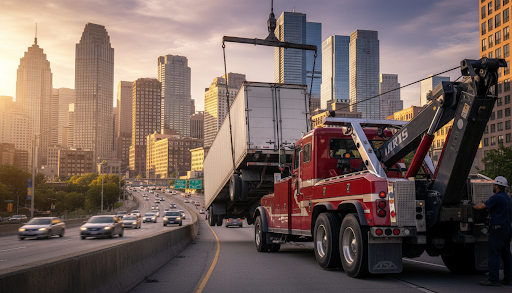
In U.S. towing and recovery, moving a disabled semi-truck or a loaded box truck is never a “hook and go” job. The right heavy duty towing equipment is picked to control weight, balance, and risk while protecting the scene.
This guide breaks down heavy duty tow truck equipment and the jobsite checks that come before the first pull. You’ll see how commercial vehicle towing equipment differs by vehicle type, damage, and where the truck sits on the road or off it.
It also helps to separate towing from recovery. Towing is moving a vehicle down the road, while recovery is uprighting, winching, extracting, or stabilizing it. That’s why heavy recovery equipment can include winches, rigging, and stabilization gear that you may not need for a straight tow.
Equipment selection is driven by GVWR and GCWR, center of gravity, terrain, and traffic exposure, not just “bigger is better.” In professional work, heavy wrecker equipment must match rated limits, with working load limits (WLL), inspection tags, and documented procedures that back up every connection.
Key Takeaways
- U.S. towing and recovery uses specialized trucks, hydraulics, and rigging to handle large commercial vehicles.
- Heavy duty tow truck equipment changes based on whether the job is towing or recovery.
- GVWR/GCWR, center of gravity, damage, terrain, and traffic exposure guide equipment choices.
- Heavy recovery equipment often adds winches, booms, outriggers, and controlled rigging.
- Heavy wrecker equipment must use rated hardware with clear WLL markings and inspection tags.
- Commercial vehicle towing equipment is only as safe as the pre-job checks and documented procedures behind it.
Understanding Heavy-Duty Towing and When It’s Needed
Drivers often wonder when heavy duty towing is needed. It’s when a big rig blocks lanes or gets stuck in soft ground. This job requires tools beyond a standard wheel-lift, like a heavy wrecker or rotator.
Heavy-duty towing is more than just pulling a vehicle. It involves control, stabilization, and managing forces safely. This is crucial when dealing with heavy vehicles, traffic, or damage.
What qualifies as “heavy-duty” in U.S. towing and recovery
In the U.S., “heavy-duty” towing includes tractors, loaded trailers, buses, and more. These vehicles have air brakes, long wheelbases, and high centers of gravity. This makes towing more complex.
Commercial truck recovery needs strict scene control. Operators might use multiple winch lines and stable anchor points. Even a short move requires careful planning to avoid damage.
Common scenarios: rollovers, jackknifes, off-road recoveries, and disabled commercial vehicles
Each towing scenario is unique. A rollover might need stabilization before being lifted upright. A jackknife requires careful alignment to avoid separation.
Off-road recoveries face challenges like low traction and soft shoulders. Crews extend rigging and build anchors to avoid sinking. Disabled commercial vehicles pose their own risks, like locked axles or air loss.
| Incident type | Main risk at the scene | Typical approach | Why equipment changes |
| Rollover | Tip, slide, or secondary roll during uprighting | Stabilize first, then controlled upright with multi-line management | Higher lift demands and precise line control to limit side load |
| Jackknife | Trailer swing, kingpin stress, or separation during repositioning | Secure and realign before pulling; manage pivot points | Needs alignment control and careful force direction |
| Off-road winch-out | Soft ground, poor traction, and unstable anchors | Longer rigging, safer anchor building, staged pulls | Requires reach, flotation planning, and reduced wheel spin |
| Disabled commercial vehicle | Locked driveline, air loss, steering limits, roadside exposure | Lift or tow with axle handling, dollies, or adapters as needed | Mechanical limits drive how the load can roll and steer |
How weight ratings (GVWR/GCWR) influence equipment selection
Weight ratings are key in towing. GVWR focuses on the single unit’s maximum weight. GCWR considers the combined weight of tractor and trailer, important for highway incidents.
Crews plan around actual weight and axle loads on scene. The need for heavy-duty towing depends on weight, complexity, and risk. This helps operators choose the right equipment for safety.
Heavy duty towing Vehicles and Tow Truck Types
When dealing with tough scenes, the truck type is crucial. Heavy duty towing vehicles are picked based on weight, access, and how to move the disabled unit without causing more damage. Heavy recovery trucks vary by boom reach, underlift strength, and stability on uneven shoulders.
Rotator tow trucks and when their lifting capacity matters
A rotator tow truck shines when a straight pull isn’t possible. Its rotating boom is perfect for side pulls around guardrails, on embankments, or when there’s no room to line up.
Lifting capacity isn’t just a number. It changes with boom extension, radius, angle, and leverage. Operators plan the pick point, swing path, and outrigger placement before lifting starts.
Heavy wrecker tow trucks for highway recovery and long hauls
A heavy wrecker is the go-to for highway work once a vehicle is stable. It’s built for winch-outs, controlled pulls, and towing heavy commercial units to safety.
These trucks have strong underlifts, multiple winches, and hydraulic power for long cycles. This keeps steering and braking in control during the hookup and tow.
Integrated tow trucks for buses and medium-to-heavy commercial units
An integrated tow truck combines the boom and underlift into the chassis. This design improves stability during front-end lifts on buses, straight trucks, and medium-to-heavy commercial units where weight can shift quickly.
With the lift system built in, the truck feels more stable during tight hookups. It’s also better when there’s little shoulder space and the casualty must be raised and centered carefully.
Landoll and lowboy options for transport vs. traditional towing
Not all scenes are safe for towing on axles. A Landoll trailer or lowboy trailer is often used for severe drivetrain damage, multiple locked axles, fire damage, missing wheels, or when hauling is preferred.
Transporting the disabled unit like cargo reduces tire scrub, limits further wear, and improves control on long distances or rough pavement.
| Equipment type | Best fit on scene | Key advantage | Common limits to plan for |
| rotator tow truck | Side pulls, lifts over barriers, tight shoulders | Rotating boom for off-angle recovery and precise placement | Capacity drops with boom extension and lift radius |
| heavy wrecker | Highway recovery, winch-outs, controlled towing after hookup | Strong underlift and sustained hydraulic pulling power | Needs room for straight-line pulling and safe winch angles |
| integrated tow truck | Buses, straight trucks, medium-to-heavy commercial units | Chassis-integrated lift improves stability during front-end raises | Less flexible than rotators for wide-offset picks |
| Landoll trailer / lowboy trailer | Transport for damaged drivetrains, locked axles, missing wheels | Loads and secures the unit for better control and reduced wear | Requires loading space, tie-down time, and route planning |
Core Towing and Recovery Gear Used on Heavy Wreckers
Heavy wreckers face challenges on busy roads or muddy sites. They use a set of tools that work together. These tools affect how stable and controlled the towing is, without causing more damage.
Underlift and wheel-lift systems for safe axle handling
An underlift system lifts axles or frame points, making towing steadier. It keeps damaged tires off the road, preventing blowouts and damage.
Wheel-lift heavy wreckers adjust for different axles and heights. It’s crucial to lift correctly to avoid damaging steering links or airbags.
Booms, winches, and recovery arms for controlled pulls
A towing boom helps in tight spaces. It works with rigging for safe, controlled movements.
The recovery winch is key for pulling. Single-line pulls are faster, while multi-line reeving offers more control. Managing tension prevents shock loads and keeps the line clean.
Outriggers and stabilization equipment to prevent tip-over
Outriggers widen the stance to prevent tip-over. They’re especially useful on uneven surfaces. They also reduce unwanted roll that can affect the pull angle.
Blocking and cribbing support the outriggers. They spread the weight and control shifts in the load. This planning prevents sudden movements during lifts.
PTO and hydraulic systems that power heavy recovery operations
A PTO hydraulic system powers the wrecker’s tools. It controls the boom, underlift, outriggers, and winch. Smooth control is key for precise movements.
Hydraulics need clean fluid and stable pressure. Leaks or low fluid can cause problems. This affects control, especially in critical moments.
| Gear on the wrecker | Primary job on scene | Key setup checks | Common risk if misused |
| underlift system | Lifts axles or approved frame points to keep a disabled unit stable in tow | Fork fit, lift height, driveline clearance, secure pinning | Suspension bind, steering damage, or driveline angle stress |
| wheel-lift heavy wrecker | Supports wheels or axles for quick pickups and controlled towing | Correct fork style, centered load, tire clearance, strap tension | Wheel scrub, bent components, or load shift during turns |
| towing boom | Provides reach for lifts, repositioning, and uprighting support | Boom angle, rated capacity at radius, rigging path clearance | Overload at long radius or swing into traffic hazards |
| recovery winch | Applies controlled pull force for extraction and alignment | Line condition, fairlead alignment, anchor point rating, reeving plan | Shock load, line damage, or uncontrolled movement |
| outriggers towing | Stabilizes the truck during side pulls and lifts | Ground strength, pad placement, level stance, cribbing support | Tip-over risk from soft ground or uneven deployment |
| PTO hydraulic towing system | Powers hydraulic functions for lifting, pulling, and holding loads | PTO engagement, fluid level, pump noise, temperature control | Loss of function, drifting loads, or overheating under demand |
Rigging, Chains, Straps, and Securement Hardware
Heavy duty towing is like engineering. Every part must be rated, matched, and checked before pulling. A weak link can ruin the plan, especially with winch rigging on uneven ground.
Grade 70 vs. Grade 80/100 chains and proper use cases
Most teams use Grade 70 chains for transport. They work well for many jobs because they’re made for securement and road use. For tougher pulls, Grade 80 and Grade 100 chains are better because they handle angles and cycles well.
Always plan with the working load limit WLL in mind, not the breaking strength. Avoid sudden, sharp pulls that can damage the chain. Make sure the chain fits the recovery plan and replace any damaged chain.
| Gear type | Where it fits best | What to verify before use | Common mismatch that causes trouble |
| towing chains Grade 70 | Roadside tie-downs and load securement heavy towing on carriers and trailers | Stamped grade, legible WLL, uniform link shape, no twist or stretch | Using as a primary recovery leg when an alloy chain is required |
| Grade 80 chain recovery | Recovery pulls, bridle legs, and controlled winch work with rated connectors | Alloy markings, correct chain diameter, smooth link wear, compatible hooks | Pairing with an underrated shackle or hook that lowers system WLL |
| Grade 100 chain towing | High-demand recovery where higher capacity and durability are needed | Grade stamps, WLL documentation, no bent links, no weld spatter or heat tint | Mixing grades in the same leg and assuming the higher grade sets the limit |
Shackles, hooks, and links: choosing rated connectors
Connectors must be clearly marked and sized for the job. Shackles need the right pin diameter and bow shape for proper load sitting. Hooks and links should match the chain, with latches that close clean and pins that thread smoothly.
Mismatched parts can hide weak points. A high-grade chain clipped into an underrated hook still performs at the lower rating. Check for bent pins, spread hooks, worn saddles, and damaged threads before each lift or pull.
Recovery straps, bridles, and soft shackles for specialty pulls
Synthetic gear is great for painted surfaces, delicate attachment points, or wider contact areas. Straps and soft shackles reduce marring and store less energy than steel setups. However, chains are better for sharp edges, hot components, and abrasive contact.
Towing bridles balance force across two points and keep the pull line centered. They also control direction, preventing the vehicle from sliding. Inspect webbing for cuts, glazing, or pulled stitching, and keep sleeves in place where rubbing is expected.
Load securement standards and working load limit (WLL) basics
Find WLL markings or tags on every part: chain, strap, hook, shackle, and link. The system is only as strong as the weakest component. Plan with a margin, especially when angles reduce capacity and the load shifts during movement.
For load securement heavy towing, aim to stop movement in more than one direction. Securement isn’t just “holding it down”; it’s resisting forward, rearward, and side motion. A careful count of tiedown points, correct angles, and a verified working load limit WLL keeps the load controlled mile after mile.
Specialized Attachments for Oversized and Heavy Vehicles
Heavy wreckers can handle big loads, but attachments make the job fit the vehicle. Different frames, axles, and suspension layouts change where you can lift and how you can pull. The right setup helps keep clearance, balance, and control when space is tight or parts are already bent.
Forks, lift adapters, and axle forks for different suspension setups
Fork choice is about shape, reach, and how the axle sits under load. With axle forks towing, the fork must match the axle tube and the suspension geometry so it seats clean and stays put. Clearance matters too, especially around brake chambers, ABS cables, and air lines.
Lift adapters heavy wrecker setups help when a standard underlift head does not line up with the pickup point. A correct adapter reduces twist and keeps lift points centered. A poor fit can slip, bend brackets, or pinch a hose when the suspension moves.
Fifth-wheel and kingpin adapters for towing semis
When a semi needs to be moved, the connection point changes the whole tow plan. A fifth-wheel towing adapter can create a stable interface when you need tractor and trailer control without relying on damaged gear. A kingpin adapter is used to engage the kingpin path correctly, so the load tracks straight and does not yaw under braking.
Locking parts must seat fully before any pull. Operators also watch jaw engagement, release handles, and safety locks, because a partial latch can shift under grade changes or uneven pavement.
Airbag recovery tools and suspension support equipment
Air suspension can drop fast after a line failure, which changes ride height and lift angles. An airbag recovery kit supports the chassis and helps manage height when air is lost. Controlled support reduces sudden movement while lifting, winching, or setting the load onto the underlift.
Support gear also helps during long pulls where suspension travel can change strap tension. Keeping the vehicle level protects fenders, driveshaft angles, and air system components from secondary damage.
Dollies and skates for locked wheels and tight access
Some casualties will not roll due to locked brakes, damaged hubs, or a seized driveline. Towing dollies heavy truck setups help carry the weight and reduce tire scrub when you need a clean exit from a lane or shoulder. They also help when you must move a unit without dragging wheels across asphalt.
For yards, docks, and cramped alleys, vehicle skates recovery tools allow short, precise moves. Skates are useful when turning radius is limited and you need to reposition in small increments without shock loading the suspension.
| Attachment | Best fit | What it helps prevent | Key check before use |
| Axle forks towing | Axles with specific tube shapes and tight clearance | Fork slip, component bend, damage to brake lines and air lines | Fork seat depth, chain retention, line clearance |
| Lift adapters heavy wrecker | Odd axle offsets, low ground clearance, non-standard lift points | Twist load, off-center lift, underlift head bind | Adapter rating, pin fit, centered pickup point |
| Fifth-wheel towing adapter | Tractor-trailer moves needing controlled tracking | Unstable coupling, sway during braking, uneven load transfer | Lock engagement, height match, latch function |
| Kingpin adapter | Kingpin interface moves when standard gear is damaged or mismatched | Partial latch shift, unintended release, tracking drift | Jaw contact, safety lock, visual confirmation |
| Airbag recovery kit | Air-ride suspensions with pressure loss or low ride height | Sudden drop, load shift during lift, crushed suspension parts | Support placement, inflation control, stable crib points |
| Towing dollies heavy truck | Locked wheels, damaged hubs, short repositioning to safe ground | Dragging damage, tire flat-spotting, lane gouging | Secure strap routing, axle alignment, dolly steering response |
| Vehicle skates recovery | Tight yards, docks, low-speed precision moves | Scrub damage, uncontrolled pivot, contact with curbs and posts | Load capacity, flat surface contact, controlled push points |
- Match the attachment to the lift point, not just the vehicle size.
- Confirm rated capacity across the full setup, including pins and retainers.
- Recheck line routing and clearance after the first lift, since suspension can settle.
Safety, Traffic Control, and Scene Management Equipment
On a busy highway, staying seen and avoiding danger lanes is key. Towing safety starts with high-visibility gear like reflective vests and gloves. Also, eye protection and proper boots and a hard hat are needed for overhead risks.
Effective traffic control for towing means setting up a work zone before starting. Warning triangles, cones, and flares help drivers see the scene early, even in bad weather. Scene lights and reflective signs guide traffic away from the wrecker.
Managing a recovery scene involves planning, not just reacting. The wrecker shields the area, and crew members have an escape path. Working with law enforcement helps manage lane closures and keeps bystanders safe.
Heavy towing also requires tools to control the vehicle and the ground. Wheel chocks and blocking stabilize a disabled truck. Fire extinguishers and spill absorbents are needed for leaks.
Good communication is crucial for a smooth pull. Two-way radios or headsets help the team call out important information. Using safety equipment correctly is vital, especially in complex situations and at night.
| Equipment | Primary safety role | Where it matters most | Use notes |
| High-visibility PPE | Makes workers visible to traffic and each other | Night calls, rain, heavy spray, glare | Keep clean and reflective; replace when faded or torn to support DOT safety gear towing |
| Warning triangles and cones | Creates early lane guidance and a buffer zone | High-speed shoulders, hills, curves | Set far enough upstream for stopping distance; core to traffic control for towing |
| Flares or LED flares | Boosts visibility and alerts distracted drivers | Dark roads, fog, power outages | Use LED around fuel spills; place to outline the taper and hazard edge |
| Scene lights and reflective signage | Improves recognition of workers, rigging, and trip hazards | Off-ramps, narrow shoulders, winter nights | Aim lights to reduce blinding oncoming drivers; supports roadside safety heavy towing |
| Arrow board (where equipped) | Directs traffic flow away from the work zone | Multi-lane interstates, long-duration recoveries | Match pattern to lane closure plan; coordinate with law enforcement for recovery scene management |
| Wheel chocks, cribbing, blocking | Prevents roll and stabilizes loads during lifting | Slopes, soft shoulders, uneven pavement | Set before lift or winch when possible; re-check after load shifts |
| Fire extinguisher and spill containment | Controls fire risk and limits fluid spread | Fuel leaks, hot brakes, damaged batteries | Stage within reach; use absorbent and drip pans to protect pavement and drains |
| Two-way radios | Coordinates commands and reduces line-of-fire exposure | Noisy scenes, long pulls, blocked sight lines | Use clear callouts for winching and stopping; prevents confusion during traffic control for towing |
Inspection, Maintenance, and Pre-Job Checks for Towing Equipment
Reliable recoveries start with a thorough towing equipment inspection. This happens in three stages: before the call, before the pull, and after the job. Each step is quick, repeatable, and documented for the next operator.
To keep checks consistent, many fleets use a walkaround and a short form. They also include clear pass/fail notes. The goal is to spot wear early, confirm controls feel right, and keep gear within rated use.
Daily checklist for winches, hydraulics, and rigging
Start with a winch inspection checklist while the truck is still staged. Check if the winch brake holds under light load and if the freespool engages cleanly. Also, ensure the line lays tight across the drum.
Look at the fairlead for sharp edges, cracks, or rollers that bind. Listen for new clicks or grinding. Next, confirm hydraulic system maintenance towing basics: fluid level in range, no milky oil, and no fresh seepage around fittings.
Scan hoses for rub marks and bulges, cycle cylinders to check for drift, and make sure every control responds without lag or chatter. Finish with rigging. Check chain links for elongation and damage, hooks for twist or throat spread, and latches that don’t fully close.
Wire rope and synthetic lines: wear signs and replacement timing
Wire rope inspection focuses on broken wires, kinks, crushing, and rust that won’t wipe away. Pay close attention near the hook, the first wraps on the drum, and any bend points where fatigue builds fast. If strands are birdcaged, flattened, or heavily corroded, pull it from service.
Synthetic winch line inspection is different. Look for fraying, glazing from heat, stiff spots, embedded grit, and UV or chemical damage that fades or weakens fibers. Keep protective sleeves in place, spool under tension, and retire the line when damage indicators show up instead of trying to “get one more pull.”
Calibration and testing for load and stability systems
Operators trust numbers only when load monitoring calibration is current. Verify the display zeros correctly, matches known test weights or approved test methods, and alarms trigger at set thresholds. If the truck uses stability aids, confirm sensors and outriggers read accurately before critical lifts or side pulls.
Documentation, tags, and compliance records
Paperwork keeps a fleet ready when the call comes in. Maintain logs that tie each inspection to an equipment ID, and keep rated capacity labels readable on winches, booms, and rigging. Clear towing compliance records also track retirement criteria, repairs, and who signed the unit back into service.
| Workflow timing | Primary check focus | What to verify | What to record |
| Before the call | Readiness walkaround | Winch brake and freespool feel, fairlead condition, hydraulic leaks, rigging tags and latch function | Pass/fail notes, fluid top-offs, damaged items flagged for removal |
| Before the pull | Set-up confirmation | Line lay on drum, correct sleeve placement, shackles fully seated, straps protected from edges, controls responsive | Rigging configuration, any substitutions, WLL match confirmation, spotter check |
| After the job | Post-use condition check | Heat or glazing on synthetic, broken wires or kinks on steel, new hose rub points, cylinder drift after cycling | Wear findings, cleaning done, retirement decisions, parts needed for repair |
How to Choose the Right Equipment for the Job
Choosing the right heavy duty towing equipment is simple. First, assess the scene and note what failed and what can shift. Good notes help avoid rework and save time.
Matching capacity to real load and angles
Match the truck’s capacity to the vehicle’s true resistance, not just its weight. Consider load shift, mud suction, and recovery angles. Boom extension and angle also affect what the truck can lift or winch.
Side pulls are risky because they stress outriggers. If you need distance or a controlled arc, choose between a rotator or wrecker wisely.
Terrain, traffic, and access constraints
Soft shoulders and broken pavement affect parking and anchoring. Limited space may mean a short tow. On fast roads, choose equipment that creates distance and shortens hook time.
Access shapes the decision between a transport trailer or tow. Dragging a damaged vehicle can cause more damage. A controlled move is safer when rolling resistance is unpredictable.
Planning rigging and controlling the pull
A good rigging plan starts with rated connections and solid anchors. Use bridles to spread force and keep the pull aligned. This reduces rotation and secondary rollover risks.
Build sets with the “weakest link” rule in mind. Ensure all hardware has compatible Working Load Limits (WLL). Keep the pull direction clean and avoid side-loaded hardware.
When to bring in additional assets
Escalate early for extreme weight, compromised ground, or tight uprighting paths. Confined-space rollovers and damaged anchor areas are reasons to call a crane. Multi-point pulls may need a second heavy wrecker.
Use a transport trailer or tow for damaged units or to relocate without stress. The right asset mix is key for clean recoveries.
| Step | What to check on scene | Equipment choice signal | Common safety verify |
| Assess | Rest position, leaks, cargo shift, tire/axle condition, ground firmness | Heavy duty towing equipment staging and best parking angle | Traffic buffer, stable footing, clear exclusion zone |
| Calculate | Weight plus incline, mud suction, and side load from offset pulls | Recovery angle planning to estimate line pull and stability needs | Confirm boom limits at planned radius and angle |
| Choose truck | Stand-off distance, lift height, need to upright, access width | Rotator vs wrecker based on reach, control, and lane exposure | Outrigger footprint, cribbing, and ground pressure check |
| Choose rigging | Rated anchor points, edge hazards, need for direction change | Rigging plan towing using bridles, blocks, and rated connectors | All components within WLL; avoid side-loaded shackles |
| Verify and execute | Communication, spotter positions, tension plan, stop points | Call a crane for recovery when lift control exceeds truck geometry | Slow tension, monitor shift, re-check lines after first movement |
| Decide movement method | Driveline damage, locked wheels, frame contact, distance to destination | Transport trailer vs tow when rolling causes damage or instability | Securement check and low-speed test pull before departure |
Conclusion
Heavy towing works best when everything fits together right. In U.S. heavy duty towing, the first step is choosing the right truck. This could be a rotator, heavy wrecker, or even a transport setup like a Landoll or lowboy.
Next, you need the right equipment. This includes underlift parts, winches, hydraulics, and outriggers. These tools help lift and pull vehicles safely.
Rigging is critical because small mistakes can cause big problems. It’s important to use gear that’s rated for the job. This means chains, shackles, straps, and bridles with clear limits and the right connectors.
Following best practices in heavy recovery is key. It keeps the recovery safe, protects the vehicle, and reduces risks for everyone involved.
Choosing the right equipment is not a guess. You need to consider the vehicle’s weight, recovery angle, terrain, and traffic. A heavy duty towing checklist helps with this.
Good inspections and clear documentation are essential for safety. They ensure you know what equipment is ready to use before you start.
If conditions are too tough, slow down and use more equipment. This could include rotators, cranes, or transport trailers. The goal is a safe and controlled recovery, not a quick one.
Posted in Heavy Duty Towing