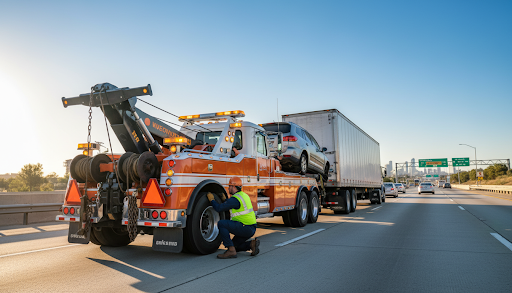
Heavy duty towing safety begins before you even start towing. In the United States, one wrong move can cause injuries, damage, and even road closures. It can also lead to expensive equipment failures.
This section explains what makes towing safe and efficient. It’s about managing risks, using the right gear, and following a set process. You’ll learn key practices for heavy towing, from the first assessment to the final unload.
Safe towing is more than just knowing how to tow. It involves following truck and equipment guidelines from brands like Peterbilt and Miller Industries. It also depends on local laws and whether the job is covered by FMCSA rules.
This guide emphasizes the importance of a checklist for towing safety. It’s about checking GVWR, GAWR, GCWR, and WLL. It’s also about clear communication, visibility, and regular checks to keep everything stable and predictable.
Key Takeaways
- Heavy duty towing safety starts with risk assessment, not the hookup.
- Heavy towing best practices rely on correct ratings (GVWR/GAWR/GCWR) and verified WLL on every component.
- A towing safety checklist reduces missed steps during inspections, securement, and re-checks.
- Safe towing procedures must follow equipment manuals, employer policy, and applicable state and federal rules.
- Tow truck safety United States standards depend on the road, the scene, and whether FMCSA oversight applies.
- Commercial towing safety improves with redundancy, strong communication, and disciplined visibility and traffic control.
Understanding heavy duty towing risks and responsibilities
Before a big rig or bus moves under tow, the risks change fast. Many people ask, what is heavy duty towing, and the answer is simple. It’s towing or recovery work that needs special gear and trained judgment.
Because stopping distance grows and forces rise, small mistakes can turn into major damage. That’s why operator responsibilities include more than driving. They also include scene control, correct equipment choices, and clear decisions that support incident prevention towing from hookup to drop-off.
What qualifies as heavy duty towing in the United States
In U.S. terms, heavy duty work often involves Class 7–8 trucks, motorcoaches, loaded semitrailers, and construction equipment. It can also mean complex recoveries that call for heavy wreckers or rotators, especially after rollovers, off-road slides, or jackknifes.
The line between medium and heavy usually comes down to combined weight, recovery complexity, and the ratings of the tow unit and attachments. FMCSA towing rules and DOT compliance towing expectations push crews to verify weights, ratings, and securement practices before the wheels roll.
| Job type | Typical vehicles involved | Why the risk rises | Common equipment focus |
| Heavy tow on pavement | Class 7–8 tractors, loaded trailers, buses | Longer stopping distance, brake heat, higher kinetic energy | Heavy wrecker with underlift, air supply, rated chains and binders |
| Recovery with load shift | Box trucks, tankers, flatbeds with cargo movement | Rollover potential, lane encroachment, unstable center of gravity | Rotator or heavy wrecker, rigging control, cribbing, stabilization |
| Construction equipment transport assist | Excavators, loaders, rollers | High point loads, clearance issues, tie-down angle sensitivity | Lowboy support, grade-rated chains, edge protection, binders |
Common accident scenarios and how they happen
One frequent trigger is overloading or mismatched ratings. This can lead to brake fade, driveline strain, tire failures, and loss of control, especially on grades or in stop-and-go traffic.
Improper hookup or securement is another. Dropped driveshafts, locked steering, chain failure, or trailer separation can start with the wrong attachment point or rushed checks during a roadside call.
Load shift can happen when tie-down angles are off or working load limits are too low for the real weight. A shift that starts as a small lean can build into a rollover risk or a sudden drift across lanes.
Recovery work adds its own hazards. Winching snapback can occur from shock loading, damaged rigging, or incorrect reeving, and it can strike with little warning if the line path is not controlled.
Struck-by incidents also remain a top threat during hookup and unloading. Low visibility, poor traffic control, and unsafe truck positioning raise exposure time on the shoulder.
Why liability, documentation, and communication matter
Towing liability often turns on what was checked, what was approved, and what was recorded. Strong paperwork helps show a duty of care: pre-tow photos, condition notes, authorization, declared load weight, and route constraints like low bridges or steep grades.
Documentation also supports DOT compliance towing when questions come up after a stop or a claim. It ties the equipment used to its ratings and shows that key steps matched policy and manufacturer guidance for tow bodies, winches, chains, binders, and snatch blocks.
Clear communication reduces errors at the scene. Two-way radios, agreed hand signals, and a single director during recoveries cut mixed messages, while written customer instructions help prevent disputes tied to FMCSA towing rules, timing, or destination changes.
Choosing the right tow truck, trailer, and equipment for the load
The safest setup starts before the hook. Pick the platform and rigging based on what you’re moving, how it sits, and what the ground looks like.
Use a simple method each time: weight first, then balance, then condition, then terrain, then the recovery plan. That keeps choices consistent, especially when the tow capacity heavy duty margin is tight.
- Identify total weight, including cargo, fuel, and add-ons like toolboxes, dollies, and underlift attachments.
- Note center of gravity and any off-center loads that can shift axle weights.
- Confirm condition: rolling, locked wheels, missing axles, or damaged steering.
- Check terrain: soft shoulder, slope, tight access, or traffic exposure.
- Choose the technique: straight tow, winch-and-drag, or lift-and-rotate recovery.
Matching vehicle ratings: GVWR, GCWR, and tow capacity
Start with GVWR, GAWR, and GCWR. GVWR is the max the truck can weigh loaded, GAWR is the max per axle, and GCWR is the max combined weight of truck plus trailer or casualty.
In GVWR GCWR towing, exceeding any rating raises brake heat, tire failure risk, and handling problems. It can also trigger roadside violations and create insurance friction after a crash.
Account for what rides on the truck, not just what’s behind it. Winches, bed gear, rigging, and spare parts can push a rear axle over GAWR even when the overall numbers look fine.
Hitch types, pintle hooks, fifth-wheel setups, and compatibility
Match the connection to the job and confirm every rating on the tag. Pintle hooks are common on equipment trailers and tolerate articulation, but the lunette size and latch condition have to match.
Fifth-wheel and gooseneck-style connections spread weight and often improve stability on heavier trailers. Heavy-duty receivers can work well too, as long as the drawbar, pin, and coupler ratings line up with the expected tongue load.
Before moving, inspect mating surfaces, locking mechanisms, and safety chains. Set the height so the trailer rides level, which helps braking and reduces sway.
When to use rotators, flatbeds, lowboys, or heavy wreckers
Truck choice should follow the recovery need, not the other way around. A rotator wrecker fits complex scenes where you need lift, rotation, and tight staging without repositioning the truck.
For a traditional pull-and-tow, a heavy wrecker can be the right tool, especially with a proper underlift and towbar setup. In heavy wrecker vs flatbed decisions, a flatbed often wins when full support transport protects the driveline or when a vehicle can’t roll safely.
Lowboy trailer towing is often used for construction equipment and tall loads that need a lower deck for clearance. The ramp angle and deck height matter as much as weight when breakover is limited.
| Platform | Best fit | Key watch-outs |
| Rotator wrecker | Heavy recovery with lifting, rotation, and limited space | Outrigger placement, ground support, swing radius, and overhead hazards |
| Heavy wrecker | Underlift towing and recoveries with controlled hookups | Front/rear axle loading, towbar angles, and steering lock on the casualty |
| Flatbed | Non-drivable vehicles needing full support transport | Approach angle, winch line path, and securement points on weak frames |
| Lowboy / lowbed | Heavy equipment with height limits and clearance concerns | Deck height, ramp traction, and load placement over trailer axles |
Critical add-ons: winches, snatch blocks, chains, and binders
Winch ratings change by drum layer, so the first wrap pulls hardest. Plan line pull for the worst case, and avoid shock loads that can snap hardware or move anchor points.
Snatch block rigging helps change the direction of pull and can add mechanical advantage. Keep blocks aligned with the sheave, avoid side-loading, and use rated shackles that match the system.
For tie-down and recovery hardware, use transport chain grade 70/80/100 based on policy, markings, and the task. Never rely on unmarked hooks or mystery chain from a scrap pile.
Set load binders WLL to match the chain and the anchor points, and add edge protection where chain crosses sharp surfaces. Don’t mix parts that don’t belong together, because the whole system is only as strong as the lowest-rated piece.
Pre-tow inspections and safety checks before you move
A heavy pull rewards discipline. A repeatable pre-trip inspection towing routine cuts down on missed steps when the scene is noisy, dark, or rushed.
Build the habit around what fails most: tires, brakes, lights, leaks, attachment integrity, and clearance. Treat the towing safety inspection like a system, not a quick look.
Walkaround inspection: tires, brakes, lights, and fluid leaks
Start at the driver’s side front and walk the same loop every time. During a brake and tire check tow truck walkaround, look for low tread, sidewall bubbles, cuts, and uneven wear that hints at alignment or suspension issues.
Check wheel fasteners for looseness and scan hubs for heat marks, grease sling, or a burnt smell. Confirm tire pressure is where it should be for the axle load, not just “looks fine.”
For brakes, listen for air leaks, verify air builds to spec, and confirm brake response before rolling. Watch for ABS warning lights and test trailer brake function when a trailer is in the mix.
Then verify headlights, brake and turn signals, marker lights, and beacons. Finish by spotting leaks—engine oil, coolant, fuel, or hydraulic fluid—because a small drip can become a road hazard under heat and vibration.
Inspecting towing points, frames, and recovery attachment locations
Before loading tension, confirm the right points on the casualty and the tow unit. A towing attachment points inspection should favor manufacturer-approved tow eyes and recovery points when they are available and accessible.
Check frames, crossmembers, and suspension mounts for corrosion, cracks, or bends that can tear under load. Avoid hooking to thin sheet metal, damaged bumper supports, or compromised brackets.
Verify underlift pins, L-arms or forks, safety latches, and retaining clips are fully seated and locked. Re-check that chains and hardware are not twisted and that contact points will not pinch hoses, wiring, or air lines.
| Checkpoint | What to look for | Why it matters | Quick confirm |
| Tires and wheels | Sidewall damage, proper inflation, loose lug nuts, heat at hubs | Prevents blowouts, wheel-off events, and loss of control | Hand gauge, visual scan, hub heat check during the loop |
| Brake system | Air leaks, full pressure build, firm pedal, trailer brake response, ABS lights | Reduces fade risk and improves stopping distance | Listen-test for leaks, pressure check, slow roll brake test |
| Lights and conspicuity | Headlights, brake/turn, markers, beacons, reflective tape visibility | Improves notice to traffic in rain, dust, and night work | Full light cycle check with hazards and brakes applied |
| Leaks and lines | Oil, coolant, fuel, hydraulic seepage; rubbed hoses or wet fittings | Limits roadside failures and slick surfaces near tires | Look under engine bay, along frame rails, and at hydraulic joints |
| Attachment hardware | Correct recovery points, straight pulls, secure pins, locked latches | Prevents detachments and sudden load shifts | Hands-on tug test after tension is applied |
Verifying load weight, balance, and clearance
Confirm the best weight number you can get, including cargo, aftermarket gear, and anything inside the casualty. Estimate axle distribution and make sure tongue or kingpin loading stays within limits.
Set the load level to reduce sway and to keep steering feel predictable. Also check overhang, ground clearance, and driveline limits, including when a driveshaft disconnect is needed or an axle lift is restricted.
Before moving, note overhead and side clearances at the scene. This is where bridge clearance towing planning starts, even before you reach the first on-ramp.
Planning the route: grade, bridges, construction, and turning radius
Plan the path like you expect the unexpected. Route planning for oversized loads should account for steep grades, tight turns, narrow shoulders, and work zones that squeeze lanes and shorten merge space.
Check bridge weight limits and low-clearance warnings early, then map safe pull-off spots for re-checks. Bridge clearance towing decisions are easier when you have options before you meet the restriction.
If the load may qualify as oversize or overweight in a state, factor permits and travel windows into the schedule. That keeps the trip predictable when traffic, weather, and enforcement change hour by hour.
Securement best practices to prevent shifting, damage, and detachments
Securing a load is more than just a chain. It involves four key parts: anchor points, tie-down devices, tensioning methods, and protection from wear. Always check everything before you start moving.
Choosing the correct tie-downs: grade, WLL, and condition
Look for clear markings on your chains. The Working Load Limit (WLL) must be stamped and match the job. For most equipment moves, a transport chain grade 70 is suitable because it’s designed for securing loads, not lifting.
Inspect each piece carefully in good light. Remove any chains, hooks, or connectors that show signs of damage. Check the load binders for safety, ensuring handles, pawls, and threads are in good condition.
| Securement check | What to look for | Why it matters on the road |
| WLL markings | Legible WLL on chain, hooks, and master links | Prevents mixing unrated parts that can fail under shock loads |
| Chain and hook condition | Elongation, hairline cracks, bent latches, heavy corrosion | Small defects grow fast during braking and bumps |
| Binder function | Ratchet movement, lever pivot wear, full engagement | Supports load binders safety by reducing back-off and sudden release |
| Matching to the load | Chains for abrasion, straps only with protection from cuts and heat | Keeps restraint strength consistent across contact points |
Chain angles, anchor points, and preventing sharp-edge abrasion
Angles affect how well a load is secured. Shallow angles can lead to the load shifting sideways. Aim for angles that resist movement in all directions, using rated anchor points.
Stay away from sharp edges and thin metal. Use protectors to prevent chains and straps from rubbing against corners. Keeping chains off sharp edges also prevents stress points that can cause breaks.
Redundancy and safety devices: secondary chains and lock checks
Redundancy is key when a primary point fails. Use secondary safety chains where needed. Always check coupler locks, pintle latches, and fifth-wheel jaws to ensure they are secure.
Lock your hardware to keep it in place. For load binders safety, secure the handles and check that ratchet binders are fully engaged. Inspect hook latches and grab hooks to prevent misalignment under vibration.
Re-check intervals: when and how to re-tension during transport
Loads settle over time. Check tie downs shortly after starting, at regular stops, and after hitting rough roads or sharp turns. This is crucial for chain WLL tie-downs as slack can build up unnoticed.
Re-tension only when it’s safe to do so. Park on a level surface, set the brakes, and chock if necessary. Keep hands away from areas where a sudden release could harm you.
On-road driving techniques for safe, stable towing
Safe towing starts with patience and space. Always manage your speed, even on local roads. Leave more space than usual because stopping takes longer with heavy loads.
Brake smoothly and early to keep the trailer stable. Sudden braking can upset the trailer and stress the brakes. On long downslopes, choose a lower gear and use engine braking to avoid brake wear.
Turns need more room than you think. Practice wide turns to avoid hitting curbs or other objects. A slow, steady turn is safer for your vehicle and the road.
Wind and traffic can cause the trailer to sway. Keep your steering small and avoid sudden lane changes. If the trailer starts to sway, ease off the gas and steer straight.
Merging and changing lanes take extra time and clear views. Signal early and check your mirrors or cameras. Avoid tight spaces that require hard braking. Adjust your following distance based on the load and road conditions.
If you break down, move to a safe area as soon as possible. Turn on hazard lights and use warning triangles if safe. Call for help instead of trying to fix it yourself. Stay calm and consistent to ensure safe towing.
| Driving situation | What to do | What it prevents | Key reminder |
| Normal traffic flow | Use speed management heavy duty towing and add substantial following distance | Rear-end crashes and panic stops | Braking distances towing increase with weight, heat, and road grade |
| Long downhill grades | Apply a downhill towing technique: downshift early and use engine braking; brake in smooth intervals | Brake fade and loss of control | Never ride the brakes; manage speed before it builds |
| Tight intersections and turns | Set up wide turns towing trailer and watch mirrors for off-tracking and rear swing | Curb strikes, tire damage, and clipped objects | Slow entry speed gives you room to correct |
| Crosswinds or passing trucks | Maintain steady throttle and small steering inputs for sway control towing | Trailer oscillation and lane departures | If sway starts, ease off throttle and hold straight |
| Merging and lane changes | Signal early, check extended mirrors/cameras, and move over with a long gap | Cut-offs and sudden braking events | Plan for trailer length and blind spots |
Worksite and roadside safety during hookup, recovery, and unloading
Start every call with a calm scene size-up. Check traffic speed and volume, shoulder strength, slope, light, and weather. Look for fuel leaks, loose cargo, and downed lines that can turn a simple job into a high-risk event.
For roadside towing safety, build a protected work area before touching gear. Use the truck as a barrier when it is safe, and add cones or triangles, beacons, and work lights. For traffic control towing recovery, coordinate early with law enforcement or a DOT response unit when lanes are tight or sight lines are short.
PPE for towing operators should match the hazards, not the weather. High-visibility apparel helps drivers see you sooner. Add gloves that can handle wire rope and chain, eye protection during rigging, and slip-resistant boots for wet pavement and soft shoulders.
Recovery zone setup should keep people out of pinch points and line-of-fire areas. Keep hands clear while tensioning hooks and shackles. Treat every loaded line as live: winch line safety means no stepping over a taut line and no standing where snapback can travel.
- Assign one spotter and use short, clear commands.
- Use rated rigging only, and avoid shock loads when the load breaks free.
- Control bystanders with a firm perimeter and clear directions.
Stabilize before you pull. Chock wheels, set brakes, and deploy outriggers on rotators when needed. Use cribbing on soft ground, and re-check that anchors and attachment points stay square as tension rises.
| Phase | Main hazard | What to do on scene | What to verify before moving on |
| Arrival and size-up | Secondary strike, poor shoulder support | Pick a safe approach, scan for spills and downed lines, set an initial buffer | Traffic flow is understood and the work area is visible from a distance |
| Recovery zone setup | Pinch zones and uncontrolled access | Place cones/triangles, park to shield when feasible, mark a controlled perimeter | Bystanders are outside the zone and equipment paths are clear |
| Winching and rigging | Snapback, flying hardware, shock loading | Maintain winch line safety, use rated shackles and blocks, keep one spotter in charge | All connections are seated, aligned, and tensioned without side-loading |
| Unloading | Runaway load, crush hazards, rollover risk | Manage unloading safety heavy equipment with slow, controlled descent and a clear path | Ground is stable, clearance is confirmed, and no one is in the travel path |
Unloading safety heavy equipment starts with the surface and the angle. Confirm the landing zone is firm, level enough, and free of soft edges. Control speed, keep personnel out of the path, and finish with a walkaround so tools, hooks, and locks are stowed for travel.
Conclusion
Heavy towing is safest when it follows a repeatable workflow. Start by sizing up risks, roles, and paperwork. Then, match the load to properly rated trucks, trailers, hitches, and rigging.
This towing safety summary comes down to planning before movement, not reacting after a problem starts.
Next, treat securement and inspection towing as non-negotiable. Stay within GVWR and GCWR, and never rely on damaged chains, hooks, or straps. Use correct WLL, clean anchor points, proper angles, and redundancy, then re-check tension after the load settles.
On the road, the best practices heavy towing are simple: slow down early, leave space, and avoid sharp inputs that start sway. At the scene, safe recovery operations mean controlling traffic exposure and keeping everyone out of the line of fire near winch lines, snatch blocks, and pinch points.
To make these habits stick, standardize the process with a written heavy duty towing checklist and frequent training. Follow manufacturer instructions, comply with U.S. regulations, and document each step so safe decisions become routine on every call.
Posted in Heavy Duty Towing