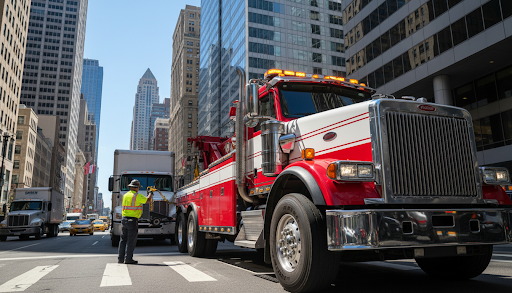
Heavy duty towing seems easy at first glance: just hook up and pull. But on U.S. highways, it’s not that simple. High weights, fast traffic, and tight spaces make it a real challenge.
This guide covers the usual problems in heavy-duty towing. It includes semi truck towing and commercial truck recovery. It also offers practical tips to avoid and fix these issues.
It’s for fleet managers, owner-operators, and roadside assistance teams. They face tough decisions quickly. Small mistakes can lead to big costs.
Breakdowns often fall into a few categories. These include safety, equipment limits, and rigging issues. Roadside help for trucks can quickly turn into a complex recovery.
For simple failures, check the equipment and hookup sections. For bigger issues like jackknifes, look at the recovery and rigging parts. And for delays, the compliance section can help.
Key Takeaways
- Heavy duty towing problems often start with unsafe scenes, limited space, and live traffic.
- Semi truck towing errors can damage axles, drivelines, and air systems if the hookup is wrong.
- Commercial truck recovery adds rigging, winching angles, and ground stability concerns.
- A heavy-duty tow truck service is only as reliable as its equipment condition and correct capacity match.
- Roadside assistance for trucks can stall due to compliance, permits, or missing documentation.
- Most towing challenges can be reduced with clear scene control, proper planning, and verified connections.
Understanding Heavy-Duty Towing in the United States
In the U.S., heavy-duty towing is more than just a number. It’s about size, risk, and the equipment needed to move a disabled vehicle safely.
Calls often happen on crowded interstates with tight shoulders and heavy traffic. The plan is as important as the pull.
What qualifies as a heavy-duty tow (weight classes and vehicle types)
Jobs in Class 7 and Class 8 towing involve weight and length. This includes straight trucks, refuse trucks, and long-wheelbase tractors and trailers.
Vehicle “class” is just the start. Operators check axle count, GVWR, and frame height. They also decide if a rotating wrecker or integrated boom is needed.
Specialties include tractor-trailer towing, bus towing, and dump truck towing. Each has unique lift points, clearance limits, and concerns.
| Heavy vehicle type | What makes it heavy-duty | Common tow approach | Key watch-outs |
| Class 7 straight truck | High GVWR, tall frame, commercial axles | Underlift with proper forks and chains | Driveline protection, limited hook points |
| Class 8 tractor-trailer | Long wheelbase, high combined weight, multiple axles | Tractor-trailer towing with air and electrical management | Fifth-wheel stress, trailer brake response, swing clearance |
| Motorcoach or transit coach | Passenger structure, low clearance, long rear overhang | Bus towing with low-angle lift and careful securement | Body damage risk, baggage bays, cooling airflow |
| Dump truck | Heavy chassis, shifting center of gravity, raised components | Dump truck towing with stabilized lift and controlled angles | Bed position, load remnants, rollover tendency on soft ground |
Common use cases: breakdowns, recoveries, load shifts, and roadside assistance
Breakdowns are often sudden and mechanical. Crews handle no-starts, engine derates, and more.
Recoveries are unique because the vehicle may not be upright. A heavy recovery service handles ditch pulls and rollovers.
Load shifts require re-securement before towing. This is especially true when the center of gravity has moved.
Roadside assistance can be complex. It includes air delivery for brakes and jump starts with high amperage.
Why heavy-duty operations differ from light-duty towing
Physics is the main difference. Heavy vehicles need longer stopping distances and higher winch forces.
Systems are also more complex. Air brakes, ABS, and electrical connections make towing a step-by-step process.
The scene is rarely simple. Lane closures and coordination with law enforcement are common, especially for Class 7 and Class 8 towing.
Safety Risks and Scene Management Challenges
Recovery work is done close to fast traffic, on uneven ground, and under tight deadlines. The main goal is to keep everyone safe while clearing the road. Heavy duty towing safety begins with careful planning, not just pulling.
Effective recovery scene management relies on clear roles. One person makes the calls, another watches the traffic, and the third checks the rigging before pulling.
Traffic control, visibility, and roadside hazards
High-speed lanes, narrow shoulders, and distracted drivers pose a constant threat. Good traffic management starts with setting up a buffer zone. Then comes the work zone, followed by an exit path for equipment.
For roadside hazard control, crews often use a simple plan. They park the wrecker to shield the hook-up area and angle wheels away from the scene. When allowed, cones, flares, and arrow boards help. But, coordination with law enforcement or the DOT decides what’s allowed and where.
Unstable shoulders, soft ground, and rollover risk
Soft ground can swallow an outrigger, and a slight slope can turn a stable lift into a tip risk. Heavy wrecker safety requires understanding the surface. This includes gravel depth, hidden drainage cuts, and the edge of asphalt that can crumble under load.
Simple habits prevent many failures. Use outrigger pads or cribbing, build the base before lifting, and tension lines in steps. If the geometry is poor, repositioning is safer than forcing the pull.
Working around fuel leaks, fires, and hazardous materials concerns
Diesel spills from saddle tanks, coolant and oil leaks, and damaged batteries are common on truck wrecks. Smoke, an active leak near hot components, or unknown cargo mean pausing, securing the area, and letting fire crews handle the hazard before towing continues.
Placards change the entire plan. Hazmat towing considerations include staying upwind, limiting ignition sources, and following isolation distances set by responders. Recovery may be delayed until containment, air monitoring, or transfer of product is complete.
Operator fatigue and communication breakdowns on long recoveries
Long pulls, night work, and bad weather wear down even experienced operators. Rotating tasks, taking short breaks, and keeping hydration and lighting in mind reduces errors. This includes dropped loads or struck-by events.
Communication should be clear and repeatable. Use radio checks, agreed hand signals, and a stop command that anyone can use. Before tensioning, confirm the rigging plan out loud, then document key steps for later review.
| On-scene risk | What it looks like in the field | Control that reduces exposure | Why it matters |
| Passing traffic and glare | Vehicles drift toward cones, rubbernecking near the taper, limited sight distance on curves | Work-zone shielding with the wrecker, phased cone taper, lighting aimed away from traffic | Protects personnel during hook-up and limits secondary crashes |
| Soft shoulder and outrigger sink | Cracking asphalt edge, mud under gravel, sudden lean during lift | Ground probe, outrigger pads, cribbing stack, shorter lifts with rechecks | Prevents tip-over and reduces frame and boom stress |
| Load shift during winching | Trailer pivots, cargo rolls, line angle changes as the unit climbs | Incremental tensioning, controlled line angles, reposition instead of side-loading | Keeps the pull predictable and reduces rollover risk |
| Fuel, battery, and unknown cargo hazards | Diesel sheen, hot brakes, sparking cables, placarded containers nearby | Spill control staging, ignition control, responder coordination, pause for specialist response | Limits fire growth and keeps recovery within response protocols |
| Fatigue and mixed signals | Missed radio calls, rushed rigging checks, inconsistent commands across crews | Single command lead, read-back on critical moves, task rotation and brief resets | Reduces preventable mistakes during high-consequence steps |
Equipment Limitations and Mechanical Failures
Heavy-duty calls can quickly turn bad when the equipment is pushed too far. The wrong truck is often the first mistake, especially when the wrecker’s capacity is tight. If the boom rating is too low, crews face limited options and lose valuable time.
Many problems start simple but turn into towing equipment failures. This happens when loads shift or the shoulder fails. Even with the right truck, small details like ballast and rigging choices can greatly affect performance.
Hydraulic issues are a common problem. Leaks, heat, and slow valve response can make the boom feel weak. Contaminated fluid can damage valves and cause uneven movement, especially in heavy traffic.
Winch failure often shows warning signs that are missed. Wire rope can have broken strands and flat spots. Synthetic line can glaze or cut on sharp edges. Problems like spooling issues, weak brakes, and overheating can stop the recovery at the worst time.
Stabilization problems are also costly. Outrigger failure can come from bent beams or uneven deployment. Without proper cribbing, the truck can shift, affecting the boom’s angle and load.
Even when the gear works, the tow truck can struggle. High weights on grades can overheat the drivetrain. Braking fade is a big risk in stop-and-go traffic. Tire damage and air system trouble add to the delay, keeping operators exposed longer.
| Failure point | What it looks like on scene | Fast checks that reduce risk | Operational impact |
| Heavy wrecker capacity mismatch | Limited rigging choices, slow progress, more repositioning | Confirm casualty weight, resistance, and planned direction before committing | Delays, higher exposure time, added liability |
| Boom rating limits | Unsafe angles, excessive flex, reach shortfalls | Verify boom angle and extension charts for the exact setup | More resets, greater risk of instability |
| Hydraulic issues | Drift, heat, slow functions, inconsistent response | Check fluid level, hose condition, cylinder seals, and filter service interval | Unplanned pauses, reduced control under load |
| Winch failure | Poor spooling, line damage, brake slip, hot drum | Inspect line, fairlead, anchors, and confirm brake hold before the pull | Stopped recovery, increased hazard in traffic |
| Outrigger failure | Pad creep, uneven stance, sudden settling | Use proper cribbing, verify ground support, recheck after tensioning | Shifted loads, higher rollover risk |
| Tow truck brake/drivetrain stress | Hot hubs, fading brakes, warning lights, tire bulge or blowout | Confirm brake feel, tire pressure, air build rate, and cooling capacity for the route | Longer clearance time, higher cost, more enforcement scrutiny |
A thorough pre-job walkaround can prevent major issues. Check hoses, fittings, winch line, rigging, lights, air systems, tires, and brake feel. Load planning should match the real setup, including boom angle and extension.
Regular maintenance keeps operations smooth. Fluid and filter service control heat and contamination. Clear wire rope retirement criteria remove guesswork. Inspected and traceable rigging reduces the risk of hidden defects causing delays.
Rigging, Winching, and Recovery Complications
When a big unit leaves the pavement, setting up is the hard part. Heavy recovery rigging fails if the plan is rushed or the load is guessed. A safe pull needs clear roles, solid signals, and space to work.
Selecting proper anchor points and avoiding structural damage
Many failures start at the attachment point. Bad anchor points include bumpers, suspension arms, steering parts, and thin crossmembers. These were not built for a straight-line pull.
Look for frame-rated locations, tow eyes, and engineered tie-in spots. Use a bridle to spread the force across two points. Also, protect edges with sleeves to avoid straps and soft shackles cutting under tension.
Line angles, load calculations, and side-loading issues
Line geometry can turn a controlled pull into a swing. Load angle forces rise with poor approach angles. Off-angle pulls can side-load booms and fairleads, steering the casualty into a ditch or lane.
Before winching a heavy truck, reposition the wrecker when you can, even if it takes more time. Use tag lines to manage drift. Consider staged pulls to reset angles as the vehicle moves.
Snatch blocks, bridles, and rigging hardware failures
Snatch block rigging helps change direction and reduce line load. But it adds more hardware that must match the job. Common issues include worn sheaves, bent side plates, and pins that are not fully seated.
Check working load limits on every shackle, hook, and strap. Keep the system rated to the highest expected tension. Avoid shock loading from sudden throttle or slack take-up, and keep all personnel out of the line-of-fire.
| Complication | What it looks like on scene | What to adjust | Why it matters |
| Weak attachment choice | Metal flexing, paint cracking, loud pops at the tie-in | Move to frame-rated recovery anchor points and add a bridle | Prevents tear-out and sudden release under load |
| Bad pull angle | Casualty crab-walking, boom twisting, line riding one side of the fairlead | Reposition, add tag lines, or change direction with a block | Reduces load angle forces and side-loading risk |
| Hardware mismatch or wear | Grooved sheaves, stretched shackles, pins backing out | Inspect, replace, and match WLL across all components | Stops progressive failures that can escalate fast |
| Shock loading | Line snap, sudden jerks, vehicle lurching during tensioning | Take slack slowly and maintain steady winch speed | Limits peak loads that exceed ratings in an instant |
Managing rollovers, jackknifes, and off-road recoveries
Rollover recovery changes the math because the center of gravity shifts as soon as the unit starts to rotate. Guardrails, soft shoulders, and ditches can snag axles and drain air lines, adding drag and unpredictable movement.
Jackknife recovery is tight because tractor and trailer angles fight each other. Stabilize first, control the trailer path, and plan the upright sequence. This way, nothing pivots into traffic or a responder zone.
heavy duty towing Operations: Vehicle Compatibility and Hookup Problems
Modern semi towing can be tricky, especially when details are missing. A simple-looking heavy duty towing hookup can become complex. This is because of trailer type, load status, and lift points.
Small details like axle spacing and fairing clearance can change everything. They can alter the whole plan.
Incorrect tow rating, mismatched wrecker capacity, and under-specced gear
A tow rating mismatch often starts at dispatch. It follows the truck to the scene. Loaded weight is often guessed, or the trailer is assumed empty.
The wrong wrecker style is sometimes sent for the recovery angle. Rotators, integrated wreckers, and detached dollies each handle weight transfer differently.
It’s good to verify axle weights when possible. Confirm tractor and trailer specs. Check if the unit is stuck, rolled, or just disabled.
This quick review helps match boom, underlift, and rigging to the actual forces involved.
| Decision Point | What to Verify On Scene | Why It Changes the Tow Plan |
| Load status | Bill of lading, shipper seal, suspension squat, and trailer ride height | Prevents a tow rating mismatch and avoids under-specced lifts |
| Tractor configuration | Wheelbase, axle count, lift axle position, and frame clearance | Improves heavy duty towing hookup fit and underlift reach |
| Trailer type | Dry van, reefer, tanker, flatbed, or lowboy; kingpin and landing gear condition | Affects stability, center of gravity, and recovery angles |
| Recovery geometry | Ditch depth, shoulder softness, traffic space, and rotation risk | Guides integrated vs. rotator choice and winch line routing |
Axle, driveline, and suspension damage caused by improper hookup
Improper lift height and strap placement can bend components. This includes axles, steering gear, suspension airbags, and frame crossmembers. A rushed pull can also cause driveline damage towing, even if the truck rolls fine afterward.
When conditions call for it, disconnecting the driveline and securing it correctly can protect the differential and transmission. Correct lift points matter, and so does confirming the steer axle tracks straight before moving out.
Air brake, ABS, and electrical connection issues
Brake and lighting problems can stall a tow before it starts. Air brake connections may leak at worn gladhand seals. The trailer may not get enough supply air to release spring brakes.
Corrosion at plugs can also knock out marker lights and turn signals. ABS towing issues often show up as warning lights, fault codes, or erratic behavior after a wiring swap.
A careful check of emergency and service lines is key. A full light and brake function test helps keep the move controlled and compliant.
Towing modern trucks with ADAS sensors and specialty components
Newer tractors add sensors and harnesses in places where chains and forks used to sit. Radar units, cameras, lane-keep hardware, and adaptive cruise parts can be close to the bumper, grille, or windshield. One wrong contact during modern semi towing can turn a routine job into a parts-and-downtime problem.
Even when the tow goes smoothly, impacts and front-end shifts can trigger ADAS calibration trucks requirements afterward. Following OEM towing guidance when available, and protecting sensor zones during the heavy duty towing hookup, reduces surprises once the truck returns to service.
Load Securement and Cargo-Related Issues
When a truck is down, the hardest part is not always the pull. Load securement problems can turn a routine call into a high-risk scene. A trailer load shift changes the center of gravity fast, which can raise rollover risk during a lift, a drag, or even a slow reposition.
Cargo shift recovery starts with a calm look at what moved and why. If pallets have leaned, straps have cut into cartons, or a bulkhead has bowed, the tow plan may need to pause. Moving too soon can increase freight damage risk and make the trailer harder to control.
Spills add another layer. Produce, paper rolls, and liquids can block access to frame points, suspension areas, and winch paths. Cargo spill cleanup coordination may be needed before any safe hookup, especially when debris spreads across lanes or into drainage.
Special loads also limit options. Refrigerated trailers may need power management to protect temperature, while high-value freight may require chain-of-custody handling and sealed doors. In these moments, FMCSA cargo securement basics help guide decisions on restraint strength, contact points, and inspection steps before rolling again.
| Cargo condition at the scene | What the towing team checks first | Common next step |
| Leaning pallets and torn stretch wrap after a trailer load shift | Floor damage, broken load bars, strap cuts, and axle loading balance | Re-secure with straps, chains, and edge protection before any transport |
| Partial spill of boxed goods blocking access | Clear path to attachment points, traffic exposure, and slip hazards | Start cargo spill cleanup coordination and request lane control as needed |
| Liquid product leak near wheels or brakes | Surface friction loss, contamination on tires, and runoff direction | Stabilize, contain, and stage towing after cleanup support arrives |
| High-value freight with intact seal | Seal status, door integrity, photo documentation, and custody controls | Document condition, limit access, and coordinate transfer or escorted move |
Before the truck moves, the crew needs a simple choice: re-secure, offload, or stabilize in place. Good photos and notes protect everyone when claims start, and they help explain why time was spent on cargo, not just the wrecker. Done right, cargo shift recovery lowers freight damage risk and keeps the roadway safer for traffic and responders.
Permits, Regulations, and Compliance Obstacles
In heavy-duty towing, paperwork can slow the job as much as traffic. A simple recovery can turn complicated once the disabled unit is hooked. This is when towing permits oversize overweight become crucial.
Route planning is key in heavy tow compliance. Bridge limits, narrow zones, steep grades, and city restrictions can force a longer path. After-hours moves add another snag when offices are closed, even if the truck is blocking a lane.
Oversize/overweight permits and route restrictions
Permits are often triggered by combined gross weight, axle weights, or dimensions after hookup. A wrecker with a towed tractor can exceed legal length fast. A raised boom can change height clearance. Measure, scale when possible, and document the setup before rolling.
Restrictions are not just about highways. Detours, temporary bridge repairs, and restricted corridors can show up with little warning. That is why many teams build alternate routes into the dispatch plan and keep permit details with the job packet.
State-by-state differences and local enforcement realities
State towing regulations vary more than most fleets expect. A permit that works in one state may not transfer across the border. Local rules can tighten things further near ports, tunnels, and downtown corridors. For cross-state recoveries, it helps to confirm requirements before the hook is made.
DOT enforcement can also feel different by region. Some areas focus on axle weights and paperwork, while others emphasize equipment condition, lighting, and safe routing. Consistent records and a calm roadside process reduce delays when an inspection starts.
Driver qualifications, logbooks, and safety documentation
Documentation gaps can turn a tough recovery into a long stop. Keep the driver qualification file current, including medical status and training records when required. Logbooks and hours-of-service details should match the type of operation and the jurisdiction.
A simple, repeatable job packet helps on every call:
- Written authorization to tow and release instructions
- Photos of vehicle condition, load shift, and hookup points
- Recorded weights, axle readings if available, and route notes
- Incident notes, property contacts, and scene sketch when needed
Insurance requirements and liability exposure for towing providers
Claims often start with small moments: a bent fairing during hookup, a cracked bumper in a tight lot, or cargo damage after a rollover. Spills, debris cleanup, and traffic control incidents can also expand towing insurance liability fast. Clear documentation before and after the tow helps separate pre-existing damage from towing-related damage.
Coverage needs can differ by job type and customer contract. Many providers review auto liability, on-hook coverage, and garagekeepers-style protection where vehicles are stored. Heavy tow compliance also includes matching the right coverage to the equipment used and the risks at the scene.
| Compliance pinch point | What triggers it | What to keep ready | Common delay or cost |
| Permit thresholds | Axle overload, added overall length, height changes after hookup | Measurements, scale ticket or axle estimates, permit confirmation details | Roadside stop, reroute, or waiting for permit issuance |
| Route constraints | Bridge postings, construction zones, grade limits, restricted corridors | Primary and alternate routes, escort notes if applicable, clearance checks | Longer miles, extra fuel, missed time windows |
| State-by-state rule changes | Crossing borders, city corridors, special facilities like ports or tunnels | State towing regulations summary, local contact numbers, permit reciprocity notes | Re-permitting, turning back, or staged transfers |
| Inspection readiness | DOT enforcement stop, complaint call, crash-related scrutiny | Driver qualification file access, logbooks, equipment inspection records | Out-of-service risk, fines, extended scene time |
| Liability exposure | Hookup damage, cargo shift, leaks, property or injury at the scene | Pre/post photos, authorization, inventory list, incident documentation | Claim disputes, deductible costs, downtime during investigation |
Cost, Timing, and Customer Expectations
Heavy-duty towing calls can quickly become complex. The cost often includes rotators, two wreckers, extra traffic control, and longer time for rigging and stabilization.
When a job turns from tow to recovery, prices can go up. This might happen if there’s a rollover, load shift, or jackknife. Winching plans, airbag lifts, and careful angle control are needed to avoid more damage.
Timing is unpredictable. Delays can come from permit waits, weather, lane closures, cargo transfers, or law enforcement holds after a crash.
Customers can help by sharing clear information early. Giving accurate details helps dispatch send the right truck the first time. This reduces downtime instead of causing repeated rollouts.
- Exact location: highway, direction, mile marker, and nearest exit
- Vehicle setup: tractor type, axle count, wheelbase, and trailer type
- Load status: loaded or empty, cargo type, and any load shift
- Incident details: ditch, rollover, jackknife, or mechanical failure
- Hazards and access: leaks, fire risk, downed lines, soft shoulder, tight turns
Providers can avoid disputes with simple, steady updates. Share a realistic ETA range, then confirm milestones like arrival, stabilization, upright, and transport. This is especially important when there are towing ETA delays.
Written authorization before major scope changes keeps approvals moving. Itemized billing tied to heavy duty towing cost factors also helps. It shows what changed and why.
| Billing category | What it covers | Common trigger |
| Labor and scene time | Operators, spotters, safety setup, traffic control coordination | Extended lane closure, difficult access, night work |
| Equipment and recovery units | Rotator, winch trucks, dollies, air cushions, power packs | Rollover, off-road recovery, bridge or median work |
| Rigging and consumables | Chains, straps, snatch blocks, bridles, edge protection | Complex pulls, multiple resets, damaged hardware |
| Mileage, storage, and handling | Loaded transport, yard time, secure parking, after-hours release | Long-distance move, delayed pickup, evidence hold |
| Cleanup coordination | Absorbents, debris handling, vendor scheduling | Fluid spill, cargo on roadway, damaged pavement |
Cost control is possible without cutting corners. Fleet roadside planning can stage local support, line up cargo services early, and pre-plan routes for oversize moves. This limits surprises in heavy recovery pricing.
When dispatch matches equipment to the call, the timeline tightens. This approach improves downtime reduction while keeping towing ETA delays and change orders to a minimum.
Conclusion
Heavy-duty towing rarely fails because of bad luck. Most problems come from scene hazards, fast traffic, or low visibility. Unstable shoulders can also cause issues.
Equipment limits, rigging complexity, and compatibility issues can make a simple tow complicated. Cargo shifts, permit delays, and cost and timing pressure make things worse.
The key to success is heavy-duty towing best practices. Good planning starts with the right assessment and truck. It also involves disciplined rigging that respects angles and weights.
Clear communication with the driver, shipper, and dispatch is crucial. It keeps expectations realistic and paperwork complete.
Use a steady checklist every time: assess the scene, secure traffic control, and verify weights and configuration. Make sure the wrecker can handle the load. Inspect the rigging and confirm hookup points.
Check air, ABS, and electrical connections before moving. Apply heavy towing safety tips on every step, especially in soft terrain or unstable vehicles.
Before rolling, address cargo stability and confirm permits and routes. Document the condition before and after. Lock in timeline and costs.
When the job is high-risk or unfamiliar, choose a heavy towing company with the right equipment and trained operators. This approach reduces surprises and ensures a safe recovery.
Posted in Heavy Duty Towing